
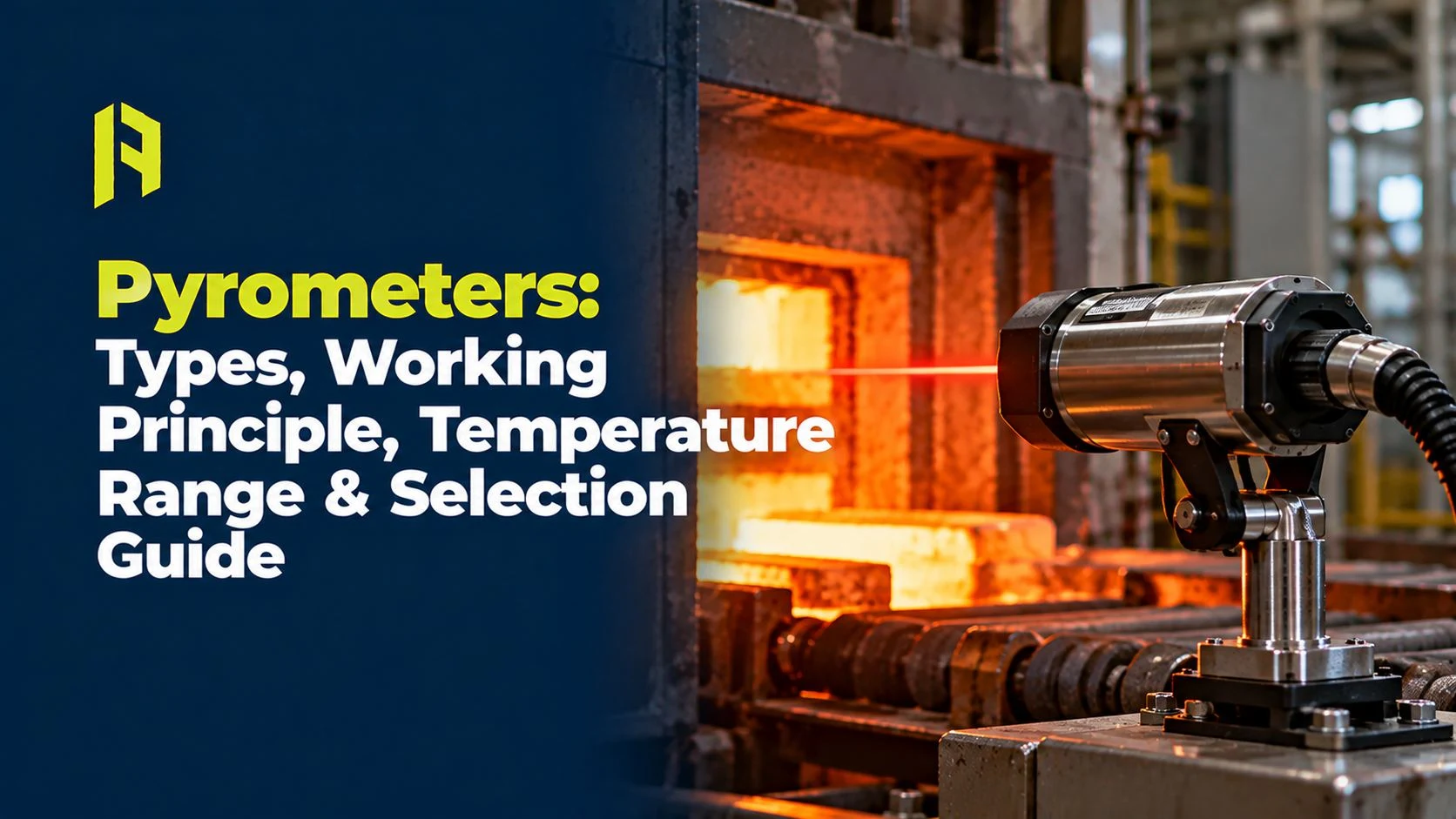
Pyrometers are temperature-measuring instruments used primarily for non-contact measurement of hot, moving, inaccessible or hazardous targets. They are widely used in metal processing, foundries, forging, heat treatment, glass production, ceramics, cement, furnaces, induction heating, semiconductor manufacturing and other industrial processes where contact sensors are difficult or too slow to use.
Modern pyrometers determine temperature from thermal radiation emitted by a target. Different designs use different wavelength bands and measurement methods, including single-color infrared measurement, optical brightness comparison and two-color or ratio pyrometry.
This guide explains how pyrometers work, compares infrared, optical, radiation and ratio pyrometers, covers emissivity, temperature range, field of view and calibration, and provides practical guidance for selecting a pyrometer for industrial temperature measurement.
What Is a Pyrometer?
A pyrometer is a temperature-measuring instrument used to determine the temperature of an object from the thermal radiation it emits.
In modern industrial use, the term usually refers to a non-contact temperature instrument. The pyrometer observes the target through an optical system, detects radiation within a defined wavelength range and converts the detected energy into a temperature value.
Because no physical probe needs to touch the target, pyrometers are particularly useful for:
- very hot materials
- moving products
- electrically energized equipment
- targets inside furnaces
- small or rapidly changing targets
- processes where sensor contact would contaminate or disturb the product
What Is Pyrometry?
Pyrometry is the measurement of temperature from thermal radiation, especially when the measurement is performed without direct physical contact with the target.
Every object above absolute zero emits electromagnetic radiation. As temperature increases, both the amount and spectral distribution of that radiation change. A pyrometer measures part of this radiation and uses a calibrated relationship between radiation and temperature to determine the target temperature.
What Do Pyrometers Measure?
Pyrometers measure the surface temperature of the target area within their field of view.
They do not normally measure internal temperature unless the observed surface is known to represent the internal process temperature.
The displayed result is commonly given in degrees Celsius or Fahrenheit, while fixed industrial systems can also provide analog or digital outputs to PLCs, recorders and process-control systems.
How Do Pyrometers Work?
A modern radiation pyrometer generally works through the following sequence:
- the optical system views a defined target area
- thermal radiation from the target enters the instrument
- an optical filter defines the wavelength band used for measurement
- a detector converts the received radiation into an electrical signal
- electronics apply calibration and emissivity-related compensation
- the instrument converts the signal into a temperature reading
The measurement is strongly affected by the target's radiation characteristics, the selected spectral range, optical alignment and anything between the target and the instrument.
Working Principle of a Pyrometer
The working principle is based on the relationship between temperature and thermal radiation.
An ideal blackbody emits a predictable amount of radiation at each wavelength for a given temperature. Real industrial surfaces emit less radiation than an ideal blackbody and can also reflect radiation from their surroundings.
The ratio between radiation emitted by a real surface and that emitted by an ideal blackbody at the same temperature is represented by emissivity.
For accurate single-color pyrometry, the instrument must use an emissivity value appropriate to the target and measurement wavelength.
Main Types of Pyrometers
Infrared Pyrometers
Infrared pyrometers detect thermal radiation in an infrared wavelength band and convert it into temperature.
They are the most common modern form of pyrometer and are available as:
- portable handheld instruments
- fixed online sensors
- fiber-optic systems
- high-speed process pyrometers
- specialized short-wavelength instruments for hot metals
Infrared pyrometers are used across a wide temperature range, but the actual usable range depends on detector technology and wavelength.
Optical Pyrometers
Traditional optical pyrometers determine temperature from visible brightness.
A classic disappearing-filament optical pyrometer allows the operator to compare the brightness of a calibrated filament with the brightness of a hot target. When the filament visually blends into the target, the instrument determines the corresponding brightness temperature.
Optical pyrometers are historically important and are still relevant to understanding high-temperature pyrometry, although modern electronic infrared instruments automate the radiation measurement.
Radiation Pyrometers
Radiation pyrometer is a broad term for instruments that determine temperature from emitted electromagnetic radiation.
Infrared, optical and ratio pyrometers can all be considered forms of radiation pyrometry depending on terminology and instrument design.
Some instruments use a relatively broad spectral band, while others intentionally measure within a narrow wavelength region to improve performance for particular materials or temperature ranges.
Single-Color Pyrometers
A single-color, single-wavelength or single-band pyrometer determines temperature from radiation intensity measured in one defined spectral band.
These instruments can provide excellent measurements when:
- the target fills the measurement spot
- emissivity is known or stable
- the optical path is clear
- the correct wavelength is selected for the material and temperature
Ratio / Two-Color Pyrometers
Ratio pyrometers measure thermal radiation in two wavelength bands and calculate temperature from the ratio of the two signals.
This technique can reduce some errors caused by partial obstruction, changing target size or uncertain emissivity when both wavelength channels are affected similarly.
However, ratio pyrometry is not automatically immune to emissivity error. If emissivity changes differently at the two wavelengths, or if the optical path affects the wavelengths unequally, measurement error can still occur.
Fiber-Optic Pyrometers
Fiber-optic pyrometers use an optical fiber to carry radiation from the target area to detector electronics located farther away.
They are useful where the measurement point is exposed to:
- strong electromagnetic fields
- restricted access
- high ambient temperature
- induction heating equipment
- mechanically difficult sensor locations
The optical fiber and lens system must be compatible with the wavelength range used by the pyrometer.
Portable Pyrometers
Portable pyrometers are handheld instruments used for spot measurements, maintenance and process checks.
They typically include an integrated display, aiming system and fixed or adjustable emissivity setting.
Fixed Industrial Pyrometers
Fixed pyrometers are permanently mounted to monitor a process continuously.
They can provide:
- fast continuous temperature measurement
- analog process outputs
- digital communications
- alarm outputs
- peak-hold or signal-processing functions
- integration with PLC and closed-loop process control
Pyrometer Type Comparison
| Type | Measurement Method | Main Strength | Typical Applications |
|---|---|---|---|
| Single-color infrared | Radiation in one spectral band | Fast, flexible and widely available | General industrial surface temperature |
| Optical | Visible brightness comparison | Traditional high-temperature measurement | Hot glowing targets and reference work |
| Ratio / two-color | Ratio of two spectral bands | Can tolerate some partial obstruction and emissivity variation | Metals, furnaces and difficult optical paths |
| Fiber-optic | Radiation transmitted through optical fiber | Remote detector and difficult-access capability | Induction heating and harsh sensor locations |
| Fixed process pyrometer | Continuous radiation measurement | Automation and fast process control | Production lines and furnaces |
| Portable pyrometer | Handheld radiation measurement | Fast spot checks | Maintenance and inspection |
Pyrometer vs Infrared Thermometer
The terms overlap heavily in modern industrial use.
An infrared thermometer is an instrument that measures surface temperature from infrared radiation. A modern infrared pyrometer works on the same basic principle.
The word pyrometer is commonly used for industrial non-contact instruments, particularly those intended for high temperatures, fast processes, fixed installations or specialized wavelength measurement.
The term infrared thermometer is broader and is often used for handheld general-purpose instruments as well as industrial devices.
Therefore, many infrared pyrometers are infrared thermometers, but the word pyrometer often implies a more process-oriented industrial instrument.
What Are Contact Pyrometers?
The term contact pyrometer appears in product searches, but traditional pyrometry refers primarily to radiation-based non-contact temperature measurement.
In some catalogs, the phrase can be used loosely for high-temperature contact thermometers or probe instruments.
For technical specification and purchasing, it is better to distinguish clearly between:
- non-contact pyrometers: measure emitted thermal radiation
- contact thermometers: use a thermocouple, RTD or another probe in physical contact with the target
FactoryMore's broader thermometer category can be used when the application specifically requires contact measurement: Thermometers.
Pyrometer vs Thermocouple
A pyrometer and thermocouple measure temperature using very different principles.
| Characteristic | Pyrometer | Thermocouple |
|---|---|---|
| Contact with target | Normally non-contact | Requires thermal contact |
| Measurement | Target surface radiation | Temperature at the measuring junction |
| Response | Can be extremely fast | Depends on junction and probe construction |
| Moving target | Well suited | Difficult in many cases |
| Very high temperatures | Often well suited | Limited by thermocouple and sheath materials |
| Emissivity effect | Important | Not applicable |
| Internal medium temperature | Not directly | Can measure when inserted into the medium |
For detailed contact-temperature guidance, see FactoryMore's Thermocouples guide.
Emissivity and Pyrometer Accuracy
Emissivity is one of the most important concepts in single-color pyrometry.
An ideal blackbody has an emissivity of 1. Real surfaces have lower values, and emissivity can change with:
- material
- surface finish
- oxidation
- wavelength
- temperature
- viewing angle
Painted, oxidized and non-metallic surfaces often behave more predictably in infrared measurement than clean, polished metals.
Incorrect emissivity settings can produce significant temperature errors, particularly when target temperature is not much higher than surrounding reflected temperatures.
Measuring Metal Temperature With a Pyrometer
Metals are a demanding pyrometry application because clean metallic surfaces can have low emissivity and strong reflectivity.
For hot metal processes, shorter measurement wavelengths are often preferred because they can reduce the temperature error caused by a given emissivity error and provide strong signal at high temperature.
Selection should consider:
- metal type
- oxidized or polished surface condition
- temperature range
- scale formation
- viewing angle
- background furnace radiation
- available target size
Optical Resolution and Spot Size
A pyrometer does not measure one infinitely small point. It measures radiation from a defined area of the target.
The optical system determines how large that measurement spot becomes at a given distance.
The target should normally fill the instrument's required field of view. If the measured spot includes cooler or hotter background surfaces, the indicated temperature can be biased.
Distance-to-Spot Ratio
Portable infrared instruments often specify a distance-to-spot ratio.
A higher ratio allows a smaller target to be measured from a greater distance, but users should read the manufacturer's optical diagram because real optical systems can have minimum focus distances and different spot definitions.
For small hot targets such as wires, induction-heated parts or narrow strips, a pyrometer designed specifically for small spot sizes may be required.
Spectral Response and Wavelength Selection
Pyrometers measure only a selected wavelength region rather than all emitted radiation.
Wavelength selection affects:
- temperature range
- detector sensitivity
- emissivity-related error
- ability to see through particular windows or atmospheres
- suitability for metals, glass, plastics or flames
Long-wave infrared bands are widely used for many lower-temperature surfaces, while shorter wavelengths are common for hot metals and high-temperature industrial processes.
How Does a Ratio Pyrometer Work?
A ratio pyrometer measures radiation intensity in two wavelength bands and calculates temperature from the relationship between them.
If smoke, dust, a dirty window or a smaller-than-expected target attenuates both channels by approximately the same proportion, the ratio can remain relatively stable even though total signal decreases.
This makes ratio instruments attractive in difficult industrial conditions.
However, ratio pyrometers still require adequate signal in both channels and can produce errors when:
- the target's emissivity differs strongly between the two wavelengths
- the optical obstruction is wavelength dependent
- background radiation enters the field of view
- the target is below the instrument's ratio measurement limit
Measuring Through Windows
A pyrometer can measure through a viewing window only if the window transmits the wavelength used by the instrument.
Ordinary transparent glass is not transparent across every infrared wavelength, so a window that looks clear to the human eye may block the pyrometer's measurement band.
Window material, thickness, contamination and temperature must therefore be considered during system design.
The instrument may require a transmission correction or emissivity adjustment to account for the window.
Smoke, Steam, Dust and Flames
Anything between the target and detector can absorb, emit or scatter radiation.
Potential sources of error include:
- smoke
- steam
- dust
- flame
- dirty protective windows
- process vapor
Specialized wavelength selection, ratio pyrometry, air-purge accessories or optical alignment strategies can improve performance, but they do not remove every possible optical error.
Pyrometer Response Time
Because radiation measurement does not require a probe to reach thermal equilibrium, pyrometers can respond much faster than many contact sensors.
High-speed instruments are used for:
- moving wire and strip
- induction heating
- forging
- rapid thermal processes
- short-duration heating events
When comparing instruments, check the specified response time and any averaging, peak-hold or signal-processing settings that can change the effective response.
What Temperature Range Can a Pyrometer Measure?
There is no single temperature range for all pyrometers.
Different detectors and wavelength bands are optimized for different ranges. General infrared instruments can measure moderate surface temperatures, while specialized short-wavelength and optical pyrometers are designed for extremely hot industrial targets.
When selecting an instrument, the target temperature should fall comfortably inside the specified measurement range rather than at the extreme limit.
The minimum measurable temperature also matters because a short-wavelength high-temperature pyrometer may not receive enough radiation from a relatively cool target.
Industrial Pyrometer Applications
Metal Processing
Pyrometers are widely used to monitor billets, slabs, strip, wire, molten-metal processes, hot rolling and continuous production.
Forging
Forging temperature strongly affects formability and final material properties. A pyrometer can measure moving hot parts rapidly without contacting the workpiece.
Heat Treatment
Pyrometers can monitor parts in furnaces, induction systems and heating stations when direct contact measurement is impractical.
Induction Heating
Non-contact measurement is particularly valuable around induction coils because contact probes can be difficult to position and electromagnetic fields can complicate some electrical sensor installations.
Glass Manufacturing
Glass requires careful wavelength selection because its optical behavior changes with wavelength, thickness and temperature.
Specialized pyrometers are used for glass surface, melt and process temperature measurement.
Cement and Ceramics
Pyrometers are used to monitor kilns, refractory materials, hot product and thermal-processing zones.
Semiconductor Manufacturing
High-speed non-contact temperature measurement is used in processes where contamination control and rapid thermal response are important.
Plastics, Film and Web Processes
Infrared pyrometers can monitor moving webs, extrusion, thermoforming and heated plastic surfaces when the spectral response is appropriate for the material.
Pyrometers in Closed-Loop Process Control
A fixed pyrometer can provide continuous temperature feedback to a PLC or controller.
The process controller can use the pyrometer signal to adjust:
- heater power
- induction power
- burner output
- line speed
- cooling rate
For closed-loop control, repeatability, response time and stable optical alignment can be as important as absolute temperature accuracy.
What Determines Pyrometer Accuracy?
Pyrometer measurement uncertainty is influenced by more than the basic instrument specification.
Important factors include:
- instrument calibration
- target emissivity
- reflected background radiation
- spectral response
- target size and field of view
- focus and alignment
- optical-window transmission
- dust, smoke, vapor and flame
- detector ambient temperature
- signal-processing settings
A high-quality pyrometer can still give an incorrect result if the target does not fill the spot or the emissivity setting is wrong.
How Do You Calibrate a Pyrometer?
Pyrometers are commonly calibrated by viewing a reference radiation source whose temperature is known from calibrated instrumentation.
A blackbody calibration source is widely used because its cavity is designed to provide a stable, high-emissivity radiation target.
A typical calibration or verification process includes:
- allow the pyrometer and reference source to stabilize
- set the blackbody source to the required temperature
- position and focus the pyrometer according to its optical requirements
- ensure the target fully fills the required field of view
- use the emissivity or calibration setting specified for the calibration setup
- compare the pyrometer reading with the reference-source temperature
- repeat at multiple temperatures when required
Calibration should cover the range and spectral conditions relevant to the application whenever practical.
What Is a Blackbody Calibration Source?
A blackbody calibration source is a controlled heated or cooled cavity designed to produce a known radiance corresponding closely to a high-emissivity reference target.
It provides a repeatable target for calibrating or checking infrared thermometers and pyrometers.
The source itself must be properly characterized and its temperature measurement traceable when used for formal calibration.
How Often Should a Pyrometer Be Calibrated?
There is no universal calibration interval for every pyrometer.
The interval should consider:
- required process accuracy
- frequency of use
- environmental exposure
- optics contamination
- instrument stability history
- quality-system requirements
- consequences of incorrect temperature measurement
Fixed instruments in critical process-control loops may require regular verification even when the detector electronics are stable because lens or window contamination can change the actual installed measurement.
Aiming and Focusing
A pyrometer must view the intended target rather than a surrounding surface.
Aiming systems can include:
- laser pointers
- through-the-lens sighting
- video cameras
- pilot lights
For fixed installations, mechanical mounting should prevent vibration and accidental movement from changing the measurement location.
Protective Accessories for Fixed Pyrometers
Industrial installations can require accessories to protect the optics and electronics.
Common accessories include:
- air-purge collars
- water-cooled housings
- protective windows
- mounting brackets
- sighting tubes
- fiber-optic heads
An air purge can help keep dust and smoke away from the lens, while cooling accessories allow the instrument to operate near high-temperature equipment without exceeding its ambient-temperature rating.
How to Choose a Pyrometer
1. Define the Temperature Range
Specify normal and maximum target temperature and choose an instrument whose measurement range comfortably covers the process.
2. Identify the Target Material and Surface
Metal, glass, plastic, ceramic and painted surfaces can require different wavelength and emissivity strategies.
3. Choose the Appropriate Spectral Range
Wavelength should match target material, process atmosphere, temperature and any viewing window.
4. Choose Single-Color or Ratio Measurement
Single-color measurement is suitable when emissivity and optical conditions are well controlled. Ratio pyrometry can be advantageous for some partially obscured or changing targets.
5. Define Target Size and Measurement Distance
Check the optical resolution and required spot size at the actual installation distance.
6. Define Response Time
Fast-moving or rapidly heated products may require millisecond-scale response, while slower furnace processes may not.
7. Evaluate Emissivity Stability
Determine whether target emissivity is known, stable or highly variable because this influences measurement technology and wavelength selection.
8. Evaluate the Optical Path
Check for dust, steam, smoke, flame, protective windows and changing target visibility.
9. Define Output and Communication Requirements
Fixed instruments can provide analog signals, alarms or digital communications for process integration.
10. Check Ambient Conditions
Verify ambient temperature, enclosure protection, vibration and cooling or purge requirements.
11. Define Calibration Requirements
For critical measurements, verify blackbody calibration capability, traceability and service support.
Explore pyrometers from industrial manufacturers and suppliers on FactoryMore: Pyrometers.
What Determines Pyrometer Cost?
Pyrometer cost varies widely because a basic handheld infrared instrument and a high-speed ratio pyrometer for a steel production line have very different capabilities.
Major cost factors include:
- temperature range
- wavelength and detector technology
- single-color or ratio measurement
- optical resolution and focus
- response speed
- measurement accuracy
- fiber-optic or special optics
- industrial outputs and communications
- environmental protection and cooling
- calibration documentation
Buyers comparing pyrometers for sale should therefore match the instrument to the process rather than choosing by maximum temperature range or price alone.
Common Pyrometer Measurement Mistakes
- Incorrect emissivity setting: one of the most common causes of single-color infrared measurement error.
- Target smaller than the measurement spot: background surfaces become part of the reading.
- Measuring polished metal with a general-purpose long-wave instrument: low emissivity and reflections can produce unstable results.
- Ignoring viewing windows: a window can block or attenuate the instrument's wavelength band.
- Measuring through smoke, steam or dust without evaluating spectral effects: the optical path can change the detected radiation.
- Assuming ratio pyrometers eliminate every emissivity problem: two-color measurement still has limitations.
- Using an instrument outside its specified temperature range: signal level or detector response may be unsuitable.
- Allowing lens contamination: deposits reduce transmitted radiation and can create gradual measurement drift.
- Ignoring reflected radiation: shiny surfaces can reflect surrounding furnaces, heaters or cooler objects.
Pyrometer Maintenance
Non-contact measurement eliminates probe wear at the target, but pyrometer optics still require maintenance.
Typical good practice includes:
- keep lenses and protective windows clean
- inspect air-purge operation
- check cooling-water flow where used
- verify mechanical alignment
- inspect fiber-optic cables for damage
- check signal outputs and communication
- perform regular verification with a suitable reference source
- recalibrate according to process and quality requirements
Pyrometer Selection Checklist
Before choosing or requesting a quotation for a pyrometer, define:
- minimum target temperature
- maximum target temperature
- target material
- surface condition and expected emissivity
- single-color or ratio measurement requirement
- spectral wavelength requirement
- target size
- measurement distance
- required spot size
- required response time
- moving or stationary target
- smoke, steam, dust or flame in the optical path
- viewing-window material if applicable
- portable or fixed installation
- analog and digital output requirements
- ambient temperature and cooling needs
- enclosure protection
- calibration and traceability requirements
Frequently Asked Questions
What are pyrometers used for?
Pyrometers are used to measure surface temperature without contact, especially on hot, moving, inaccessible or hazardous targets in industrial processes.
What are the two main types of pyrometers?
A common broad classification is single-color radiation pyrometers and ratio/two-color pyrometers. Traditional optical pyrometers and modern infrared pyrometers are also common practical categories.
How do pyrometers work?
They collect thermal radiation emitted by a target, detect radiation in a selected wavelength band and convert the measured radiation into a temperature value using instrument calibration and emissivity-related settings.
What do pyrometers measure?
Pyrometers measure the surface temperature of the target area viewed by their optical system.
What is another name for a pyrometer?
Modern pyrometers are often described as infrared thermometers, infrared temperature sensors, radiation thermometers or non-contact temperature sensors, depending on design and application.
What is the difference between a pyrometer and an infrared thermometer?
The terms overlap. A modern infrared pyrometer is an infrared thermometer, while the term pyrometer is often used for industrial, high-temperature, fixed or specialized non-contact instruments.
What is the difference between a thermocouple and a pyrometer?
A thermocouple must reach the temperature of its measuring junction through physical contact, while a pyrometer determines surface temperature remotely from thermal radiation.
What is an optical pyrometer?
An optical pyrometer determines high temperature from visible thermal radiation. Traditional disappearing-filament designs compare the brightness of a calibrated filament with the brightness of the hot target.
What is a ratio pyrometer?
A ratio pyrometer measures radiation in two wavelength bands and calculates temperature from the ratio of the two signals. It can perform better than single-color measurement in some partially obstructed or variable-emissivity applications.
What temperature range can a pyrometer measure?
The range depends on detector type and wavelength. Different instruments are designed for moderate-temperature surfaces, high-temperature metals or extremely hot furnace and process applications, so the manufacturer's specified range should be matched to the target.
How do I calibrate a pyrometer?
Pyrometers are commonly calibrated or verified against a controlled blackbody radiation source. The instrument views the reference target at one or more known temperatures and its indication is compared with the calibrated source value.
Are pyrometers contact thermometers?
Traditional and modern industrial pyrometers are primarily non-contact radiation thermometers. The phrase contact pyrometer is sometimes used loosely in catalogs for probe instruments, but technically those are better described as contact thermometers.
Are pyrometers accurate?
They can provide accurate industrial temperature measurements when the instrument, wavelength, emissivity, target size, optical path and calibration are appropriate. Incorrect emissivity or poor optical setup can create large errors even with a high-quality instrument.